题目描述
Problem Description
Please note the unusual time limit.
Xiao C has a complete binary tree with $dep$ levels and $n$ nodes. She wants to choose a connected block that includes the root node to color. She wonders how many different coloring schemes there are, with the answer modulo $998,244,353$.
Input Format
Multiple test cases are given. The first line contains an integer $T$, indicating the number of test cases.
For each test case:
The first line contains an integer $dep$, as described in the problem.
The second line contains an integer $s$, representing the number of leaf nodes at the lowest level. Specifically, $s$ is represented as a $dep$-bit binary string, which you will read. If the binary representation of $s$ is less than $dep$ bits, it will be prefixed with zeros.
The data is guaranteed to be valid.
Output Format
For each test case, output a single integer on a new line, representing the number of valid coloring schemes.
Sample Input and Output
Input Sample #1
1
2
10
Output Sample #1
4
Input Sample #2
1
3
100
Output Sample #2
25
Input Sample #3
1
3
010
Output Sample #3
10
Input Sample #4
See attachment
Output Sample #4
See attachment
Notes
You can learn about the terms used in the problem by studying OI-Wiki Tree Basics.
Sample Explanation
For Sample #1, the binary tree can be drawn as follows:
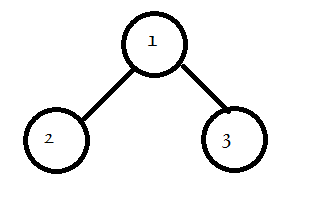
We number the nodes of the binary tree using pre-order traversal (as shown in the figure), resulting in the set $\left(1,2,3\right)$.
Thus, only $\left(1,2,3\right),\left(1,2\right),\left(1,3\right),\left(1\right)$ are valid coloring schemes.
For Sample #3, the binary tree can be drawn as follows:
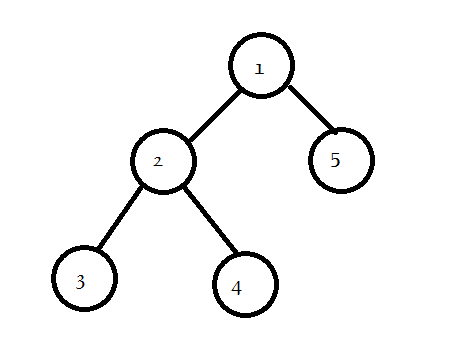
We number the nodes of the binary tree using pre-order traversal (as shown in the figure), resulting in the set $\left(1,2,3,4,5\right)$.
Thus, only $\left(1,2,3,4,5\right),\left(1,2,3,4\right),\left(1,2,3\right),\left(1,2,4\right),\left(1,2\right),\left(1,2,3,5\right),\left(1,2,4,5\right),\left(1,2,5\right),\left(1,5\right),\left(1\right)$ are valid coloring schemes.
Clearly, $\left(2,3,4\right),\left(1,3,4\right)$ are not valid coloring schemes, as the former does not include the root node, and the latter does not form a connected set of nodes.
Data Constraints
For $30\%$ of the data, $1 \leq T \leq 10, 1 \leq dep \leq 20$.
For another $20\%$ of the data, the tree is a full binary tree (i.e., a perfect binary tree).
For $100\%$ of the data, $1 \leq T \leq 10, 1 \leq dep \leq 10^6$.
输入格式
见题面 Input 部分
输出格式
见题面 Output 部分