题目描述
Problem Description
First, a tree with $n$ nodes rooted at $1$ is given, defined as the "unit tree".
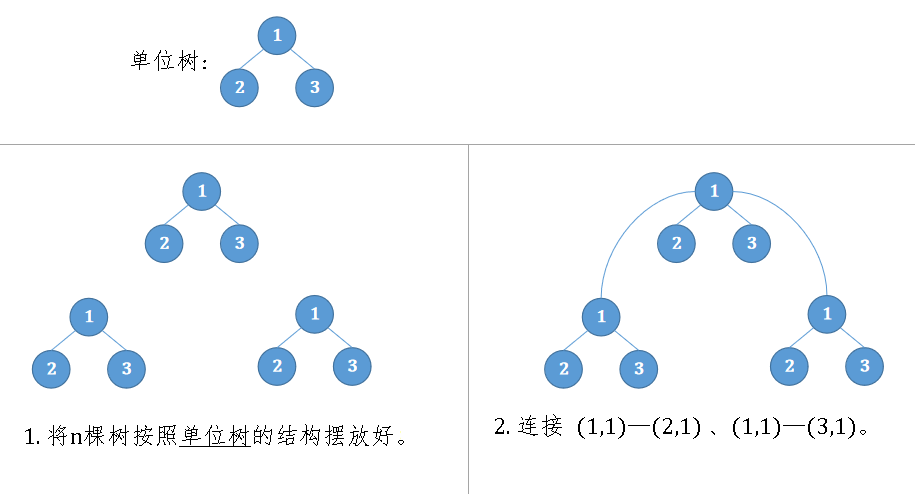
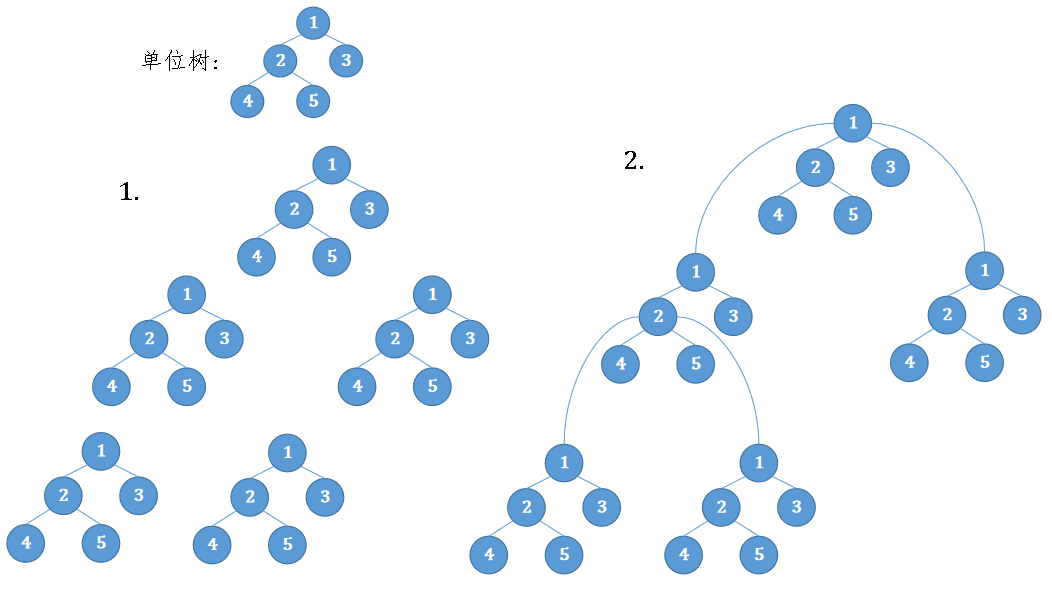
There are $n$ trees, each identical in structure to the "unit tree", and we need to connect these $n$ trees using $n-1$ edges.
For convenience, we use the notation $(a, b)$ to represent the node with number $b$ in the tree represented by node $a$.
The connection method is as follows:
-
Arrange the $n$ trees according to the structure of the "unit tree".
-
For each $i (1 < i \leq n)$, connect node $(i, 1)$ and node $(f_i, f_i)$, where $f_i$ represents the parent of node $i$ in the "unit tree".
Find the maximum number of nodes in the simple path between any two nodes in the tree that contains $n^2$ nodes after connecting the $n$ trees.
Input Format
The first line contains a positive integer $n$, representing the number of nodes in the "unit tree".
The next $n-1$ lines each contain two positive integers $u, v$, representing an edge in the "unit tree".
Output Format
Output a single positive integer, representing the maximum number of nodes in the simple path between any two nodes in the tree.
Sample Input and Output
Sample Input #1
3
1 2
1 3
Sample Output #1
5
Sample Input #2
5
1 2
1 3
2 4
2 5
Sample Output #2
9
Sample Input #3
9
1 2
1 3
1 4
1 5
2 6
2 7
5 8
5 9
Sample Output #3
11
Sample Input #4
5
1 2
2 3
2 4
2 5
Sample Output #4
8
Notes
Sample Explanation
For Sample #1, refer to the image at this link.
For Sample #2, refer to the image at this link. The path between $(3,4)$ and $(4,4)$ contains 9 nodes, with a length of 9.
For Sample #3, refer to the image at this link. The path between $(6,6)$ and $(9,9)$ contains 11 nodes.
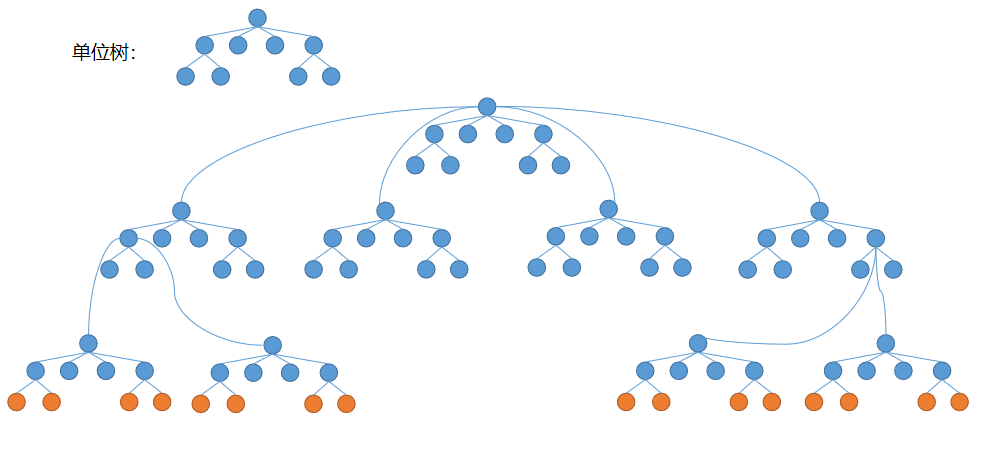
In fact, any two orange nodes with the nearest common ancestor as $1$ will yield an answer of 11.
Data Range
This problem is bundled with subtasks.
| Subtask ID | Score | $n \le$ | Special Conditions |
|---|---|---|---|
| 1 | 10 | 10 | $\times$ |
| 2 | 12 | $10^6$ | $v = u + 1$ |
| 3 | 6 | $10^6$ | $u = 1$ |
| 4 | 18 | $= 2^k (k \in \mathbf{Z})$ | $u = \left\lfloor \frac{v}{2} \right\rfloor$ |
| 5 | 27 | $10^3$ | Random tree shape |
| 6 | 27 | $10^6$ | $\times$ |
For 100% of the data: $1 \leq n \leq 10^6$, node numbers range from $1$ to $n$.
This problem may have tight time constraints.
The time limit is reduced to 1 second for the following reasons:
- The discussion forum suggests that this problem is similar to an existing one, and to prevent the so-called "enhanced version" with an $O(n \log n)$ solution from passing directly, the time limit is reduced.
- The optimal solution can run within 200ms.
- Due to the laziness of the problem setter, and the inability to increase $n \le 10^6$ to $n \le 10^7$, the time limit is reduced to block the so-called original problem solutions (which are actually incorrect).
输入格式
见题面 Input 部分
输出格式
见题面 Output 部分