题目描述
Problem Description
Cube Word is a special word-filling game. Before starting, you need to choose the side length $a$ of the cube, and then you can create a cube consisting of $a^3$ unit cubes. This large cube has 12 edges. Then, you remove all unit cubes that do not touch the edges of the large cube. The following image shows the final cube when $a=6$.
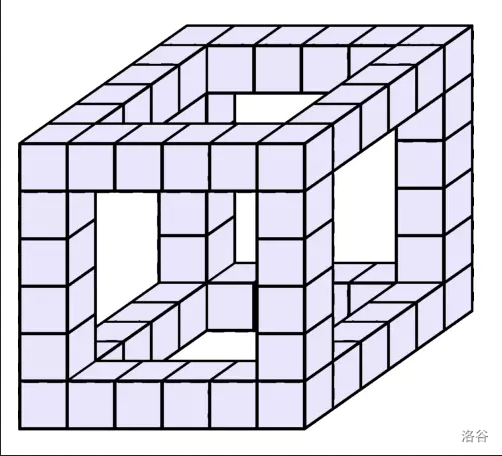
Finally, you need to fill each remaining unit cube with a letter. After filling the cube, each edge should form a meaningful word. Each edge can be read in both directions, as long as it makes sense in one direction.
The following image shows a cube when $a=6$. Some unit cubes have already been filled with letters. You can already read the words SUBMIT, ACCEPT, and TURING along three edges of the large cube.
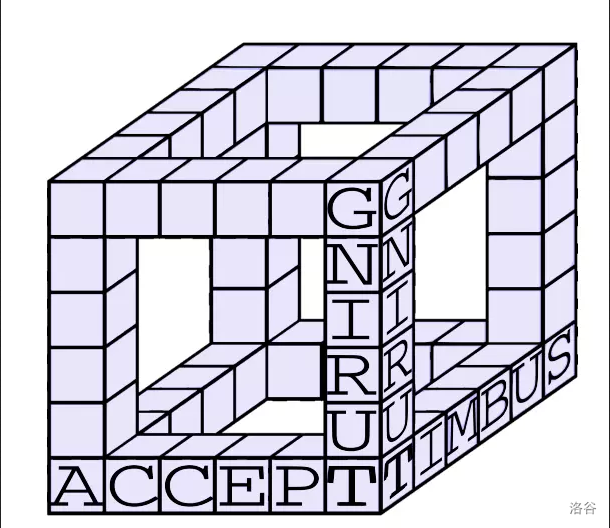
Given a series of meaningful words, each word can appear on any legal edge of the cube. Calculate the number of different cubes that can be constructed, modulo $998244353$.
Even if a cube can be transformed into another cube by rotation or mirroring, these two cubes are considered different.
Input Format
The first line contains an integer $n$, the number of words.
The next $n$ lines each contain a word that can appear on the edges of the large cube. The length of each word is between 3 and 10, inclusive.
All words are guaranteed to be unique.
Output Format
Output a single integer, the number of different cubes that can be constructed, modulo $998244353$.
Sample Input and Output
Sample Input #1
1
radar
Sample Output #1
1
Sample Input #2
1
robot
Sample Output #2
2
Sample Input #3
2
FLOW
WOLF
Sample Output #3
2
Sample Input #4
2
baobab
bob
Sample Output #4
4097
Sample Input #5
3
TURING
SUBMIT
ACCEPT
Sample Output #5
162
Sample Input #6
3
MAN1LA
MAN6OS
AN4NAS
Sample Output #6
114
Notes/Hints
Sample Explanation #1
In the first sample, the only possibility is that all edges of the cube are filled with the word radar.
Sample Explanation #2
In the second sample, there are two cubes, one of which can be obtained by rotating the other. All edges of the cube are filled with the word robot, and the difference between the two cubes is whether the letter in the bottom left corner is r or t.
Sample Explanation #3
The third sample is similar to the second, noting that the reading direction does not affect the answer.
Sample Explanation #4
In the fourth sample, if the word bob is filled on all edges of the cube, there is one cube. There are $2^{12} = 4096$ cubes where all edges are filled with the word baobab (for each of the 12 edges, we have two possible reading orders).
Data Range
For all data, $1 \le n \le 10^5$.
Detailed subtask constraints and scores are as follows:
| Subtask Number | Constraints | Score |
|---|---|---|
| 1 | Words contain only lowercase a to f |
$21$ |
| 2 | Words contain only lowercase a to p |
$29$ |
| 3 | Words contain lowercase a to p and uppercase A to P |
$34$ |
| 4 | Words contain lowercase a to z, uppercase A to Z, and digits 0 to 9 |
$16$ |
输入格式
见题面 Input 部分
输出格式
见题面 Output 部分