题目描述
Problem Description
Cirno defines a type of graph: the cylindrical network \( G(L, x) \).
\( G(L, x) \) represents a graph with \( L \times x \) nodes.
Each node is represented by an integer pair \( (a, b) \) where \( 1 \le a \le L \) and \( 1 \le b \le x \).
For \( \forall i \in (1, L], \ j \in (0, x] \), there is an edge between node \( (i, j) \) and node \( (i - 1, j) \).
For \( \forall i \in [1, L], \ j \in (0, x) \), there is an edge between node \( (i, j) \) and node \( (i, j + 1) \).
For \( \forall i \in [1, L] \), there is an edge between node \( (i, x) \) and node \( (i, 1) \).
Now, Cirno wants to know the number of independent sets in \( G(L, x) \).
Since you do not have high precision, you need to take the answer modulo \( 998244353 \).
Input Format
One line containing two integers, \( L \) and \( x \).
Output Format
One line containing one integer, the number of independent sets in \( G(L, x) \) modulo \( 998244353 \).
Sample Input and Output
Sample Input #1
3 4
Sample Output #1
181
Sample Input #2
1000 8
Sample Output #2
124141757
Notes
For the first \( 10\% \) of the data, \( L, x \le 8 \).
For the first \( 30\% \) of the data, \( x \le 8 \).
For the first \( 50\% \) of the data, \( x \le 11 \).
For \( 100\% \) of the data, \( 0 < L \le 10^{18}, 0 < x \le 17 \).
This problem uses bundled testing.
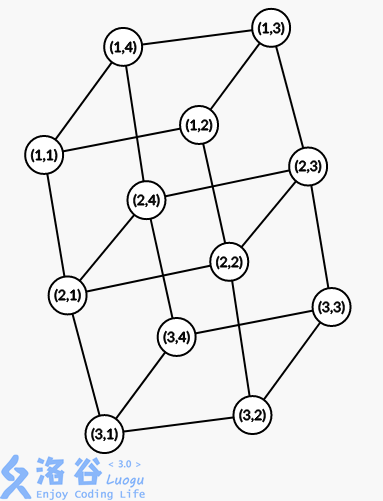
The following image is an example of \( G(3, 4) \).
输入格式
见题面 Input 部分
输出格式
见题面 Output 部分