题目描述
Problem Description
There is a grid board with $n$ rows and $m$ columns, where both $n$ and $m$ are odd numbers. The grid is covered with some $1 \times 2$ building blocks. These blocks can be rotated and cannot overlap. There are exactly $\frac{nm-1}{2}$ blocks, which means there is only one empty cell on the grid board.
You can perform two types of operations:
- Rotate a block adjacent to the empty cell (sharing a side) $90^\circ$ into the empty cell.
- Move a block adjacent to the empty cell into the empty cell.
As shown in the figure (the moved block is lighter in color):
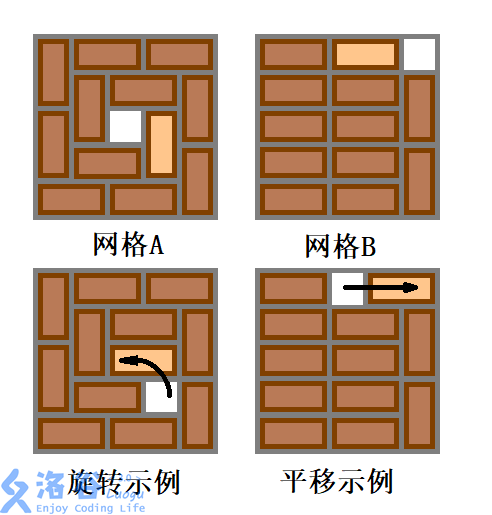
Please use the above two operations to transform the given grid board into a specified state.
Input Format
The first line contains two positive odd numbers $n$ and $m$, representing the number of rows and columns of the grid, respectively.
The next $n$ lines, each containing $m$ characters, describe the initial state of the grid board:
<indicates the left half of a block.>indicates the right half of a block.nindicates the upper half of a block.uindicates the lower half of a block.oindicates the empty cell.
The following $n$ lines, each containing $m$ characters, describe the target state of the grid board, using the same format as above.
Output Format
You need to output a string representing the sequence of your operations in order:
Lindicates moving the block to the left of the empty cell.Rindicates moving the block to the right of the empty cell.Uindicates moving the block above the empty cell.Dindicates moving the block below the empty cell.
If there are no operations, output an empty string.
Sample Input and Output
Sample Input #1
3 3
nnn
uuu
o<>
<>n
<>u
<>o
Sample Output #1
URLR
Sample Input #2
5 5
n<><>
un<>n
nuonu
u<>un
<><>u
<><>o
<><>n
<><>u
<><>n
<><>u
Sample Output #2
RLLRLRR
Notes
Data Range and Notes
The length of your output operation sequence should not exceed $8 \times 10^6$.
For all data, $1 \leq n, m \leq 2000$.
- For $10\%$ of the data, $n, m \leq 3$.
- For another $10\%$ of the data, $n, m \leq 5$.
- For another $20\%$ of the data, $m = 3$.
- For another $20\%$ of the data, $n, m \leq 50$.
- For another $20\%$ of the data, $n, m \leq 200$.
- For the remaining $20\%$ of the data, there are no special restrictions.
SPJ Notes
Refer to https://www.luogu.org/discuss/show/114298, thanks to @M_sea for the contribution.
输入格式
见题面 Input 部分
输出格式
见题面 Output 部分