题目描述
Background
Everything in the world is so巧妙, the ocean of mathematics allows me to wander endlessly, and in that moment, I discovered beauty again.
Langze, the great mathematician of Zhencheng Ocean, responded to the call of the Zhencheng Ocean Hall Master and participated in this problem-setting.
Based on his thoughts and calculations, he came up with an interesting problem. Here is what he has to say to you:
Problem Description
The inspiration for this problem comes from this set of data:
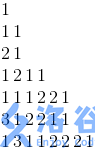
This set of data follows the descriptive method rule, where the $ n+1 $th layer describes the data of the $ n $th layer from left to right. The description rule is as follows: Starting from the first data, whenever a consecutive sequence of $ a_1 $ $ b_1 $s is encountered, $a_1\,b_1$ is written as two new data at the end of the $ n+1 $th layer (this end is appended after the last data, and if the $ n+1 $th layer has no data initially, then this end is the beginning). Immediately after, the next consecutive sequence of $ a_2 $ $ b_2 $s ($b_1 \neq b_2$) is described, and so on, until all data is described, at which point the $ n+1 $th layer is also constructed. Here, $ n $ is a positive integer.
Now, I have a new idea. Given an initial data $ Q $ (the initial data is on the first layer, and the first layer has only one data—the initial data $ Q $), construct a set of data following a similar rule (descriptive method), called the "Langze Array". I define the rule as follows: Follow rule $ A $ on odd layers and rule $ B $ on even layers. The specific performance is shown in the following figure:
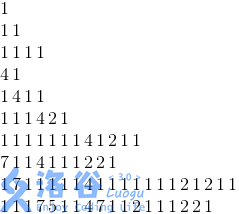
The above figure shows part of the Langze Array when the initial data is $ 1 $. As for what the rules are, you need to explore them.
But!!!
This is not the final purpose. What I want to test is, in the $ i $th layer, how many $ x $s are there (we define the layer where the initial data is located as the first layer)?
Input Format
The input consists of a single line containing three integers $ Q $, $ i $, and $ x $, separated by a space.
$ Q $ is the initial data for the Langze Array.
Output Format
The output consists of a single line containing an integer, representing the number of $ x $s in the $ i $th layer.
Since the output data is large, please take the modulo of the output data with $ 20171111 $ (i.e., the remainder of the original output data divided by $ 20171111 $ as the final output data).
Sample Input and Output
Sample Input #1
2 2 2
Sample Output #1
1
Sample Input #2
2 14 5
Sample Output #2
12
Notes
Sample 1 Explanation:
The constructed Langze Array (a small part) is:

Thus, the number of $ 2 $s in the $ 2 $nd layer is $ 1 $.
Note:
All data are integers;
If you have no clue, you can choose to solve some sub-problems;
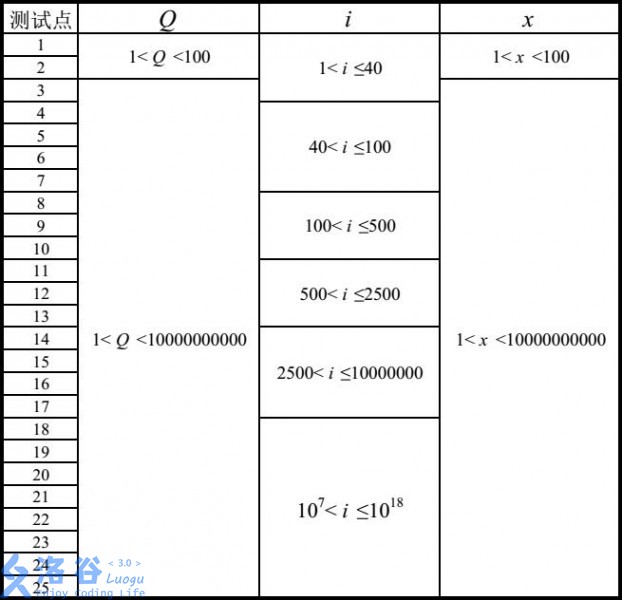
The following is the range of input data for each test point:
输入格式
见题面 Input 部分
输出格式
见题面 Output 部分