题目描述
Problem Description
There is a string set $S$, which differs from the mathematical concept of a set in that it can contain duplicate elements. Initially, $S$ contains $n$ strings $s_1, s_2, \cdots, s_n$. There are two types of operations:
- Add a string that already exists in $S$ to $S$.
- Select two strings from $S$ and add the concatenated result to $S$.
We want to know the maximum length of the longest palindromic substring that can be found in all strings in $S$ after performing any number of operations. If the length can be infinite, you need to output $\text{Infinity}$.
Input Format
The first line contains an integer $n$, representing the initial size of the set.
The next $n$ lines each contain a string. The string on the $i$-th line is $s_i$. It is guaranteed that the strings only contain lowercase English letters.
Output Format
If the length of the longest palindromic substring is not infinite, output an integer representing its length; otherwise, output $\text{Infinity}$.
Sample Input and Output
Sample Input #1
3
abc
abacde
ecab
Sample Output #1
7
Sample Input #2
1
ha
Sample Output #2
Infinity
Notes
Sample Explanation
In the first sample, concatenating $\text{ecab}$ and $\text{abacde}$ results in $\text{e}\underline{\text{cababac}}\text{de}$, where the underlined part is the longest palindromic substring with a length of $7$. It can be proven that no longer palindromic substring exists.
In the second sample, any number of $\text{ha}$ can be concatenated to form palindromic substrings of any odd length, such as $\underline{\text{h}}\text{a}$, $\underline{\text{hah}}\text{a}$, $\underline{\text{hahah}}\text{a}$, etc. Therefore, the answer is infinite, and $\text{Infinity}$ is output.
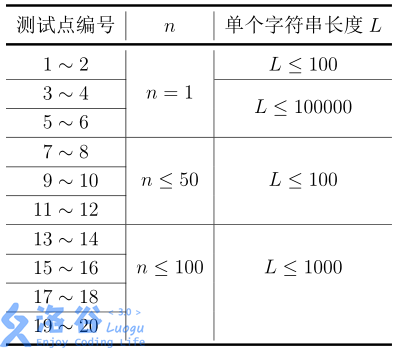
Data Size and Constraints
输入格式
见题面 Input 部分
输出格式
见题面 Output 部分