题目描述
Problem Background
xht enjoys studying mathematical functions, especially the inverse proportional function.
Problem Description
We know that the graph of the inverse proportional function \(xy = a\) is a hyperbola.
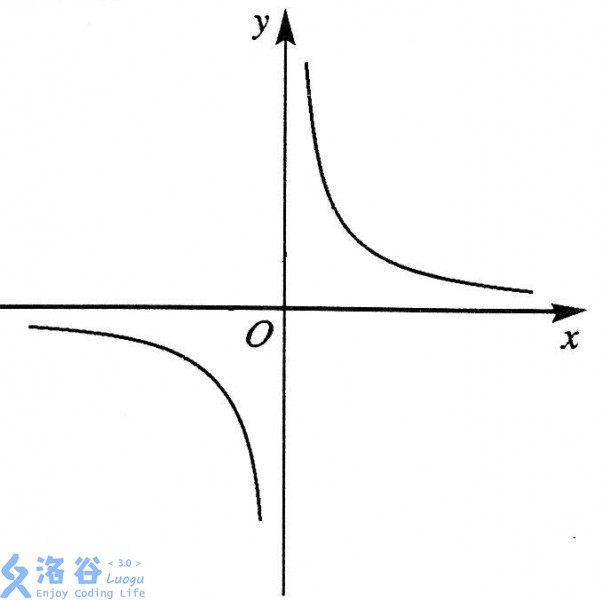
xht wonders: what would it look like in three dimensions?
Define the surface \(C(k)\) as the surface determined by the equation \(xyz = k\).
Next, define the aesthetic value \(P(k)\) of the surface \(C(k)\) as the sum of the squares of the Manhattan distances from all integer points (where \(x\), \(y\), and \(z\) are integers) to the origin.
(The Manhattan distance from point \((x, y, z)\) to the origin is \(|x| + |y| + |z|\).)
Now, xht arranges a series of surfaces \(\{C(a), C(a+1), \ldots, C(b)\}\) in a row, and you are to find the sum of their aesthetic values modulo 10007.
Input Format
A single line containing two positive integers \(a\) and \(b\).
Output Format
A single number.

Sample Input and Output
Sample Input #1
3 3
Sample Output #1
300
Sample Input #2
64 19260817
Sample Output #2
9932
Notes
Explanation of Sample 1:
On the surface \(xyz = 3\), there are 12 integer points: \((1, 1, 3)\), \((1, 3, 1)\), \((3, 1, 1)\), \((-1, -1, 3)\), \((-1, -3, 1)\), \((-3, -1, 1)\), \((1, -1, -3)\), \((1, -3, -1)\), \((3, -1, -1)\), \((-1, 1, -3)\), \((-1, 3, -1)\), \((-3, 1, -1)\). The sum of the squares of their Manhattan distances to the origin is \(5^2 \times 12 = 300\).
For 20% of the data, \(a = b \leq 100\).
For another 40% of the data, \(a, b \leq 3 \times 10^5\).
For 100% of the data, \(1 \leq a, b \leq 3 \times 10^8\).
输入格式
见题面 Input 部分
输出格式
见题面 Output 部分