题目描述
Background
HansBug, the novice, is in a chemistry exam, scratching his head countless times, yet his mind remains blank.
Problem Description
HansBug is faced with a chemical synthesis problem. According to his knowledge, the answers usually follow this format:
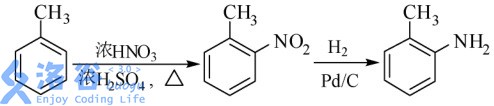 (continued on the next line)

A brief explanation: Each compound can be synthesized into another compound through one step of reaction (referred to as one step reaction, denoted as $A \rightarrow B$). Assuming that in each $A \rightarrow B$, theoretically, one unit of $A$ can only produce one unit of $B$. However, practical experiments show that there is no absolute perfect chemical conversion, and the conversion rate is denoted as $C$ (i.e., one unit of $A$ can actually produce $C$ units of $B$, where $0 < C < 1$).
HansBug's knowledge system includes $N$ such $A \rightarrow B$ conversions. The problem requires HansBug to synthesize compound $T$ from one unit of compound $S$. However, his brain cells and RP are exhausted, so the arduous task of finding the synthesis route with the highest final yield falls on you!
Input Format
The first line contains four integers: $N, M, S, T$, representing the total number of compounds, the number of reactions HansBug knows, the starting compound number, and the ending compound number (where $1 \le S, T \le N$).
Lines $2$ to $M+1$ each contain two integers and one real number: $A_i, B_i, C_i$, representing that the $i$-th reaction is from one unit of compound $A_i$ to $C_i$ units of compound $B_i$.
Output Format
One line containing a real number, representing the final yield under the optimal route (rounded to four decimal places). If there is no feasible route, output orz.
Sample Input and Output
Input Sample #1
3 3 1 3
1 3 0.8
1 2 0.9
2 3 0.9
Output Sample #1
0.8100
Input Sample #2
3 3 2 1
1 3 0.8
1 2 0.9
2 3 0.9
Output Sample #2
orz
Notes
In Sample 1 and Sample 2, the synthesis routes are $1 \rightarrow 3$ and $1 \rightarrow 2 \rightarrow 3$, with conversion rates of $0.8$, $0.9$, and $0.9$ respectively.
In Sample 1, there are two feasible routes: $1 \rightarrow 3$ and $1 \rightarrow 2 \rightarrow 3$, with final yields of $0.8$ and $0.9 \times 0.9 = 0.81$ respectively. Therefore, the second route is better with a yield of $0.8100$.
In Sample 2, compound $2$ can only produce compound $3$, and compound $3$ cannot produce any other compound, so it is impossible to synthesize. HansBug has no choice but to output orz.
[Data Range]
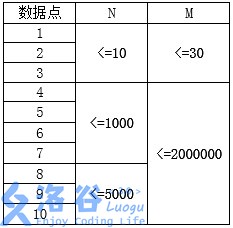
输入格式
见题面 Input 部分
输出格式
见题面 Output 部分