题目描述
Problem Description
There is a game of taking numbers. Initially, a ring is given, and each edge of the ring has a non-negative integer. Among these integers, at least one is $0$. Then, a coin is placed on a node of the ring. The two players start the game from this node where the coin is placed. They take turns following these rules:
- Choose an edge to the left or right of the coin, and the number on this edge must be non-zero;
- Reduce the number on this edge to any non-negative integer (it must be reduced at least a little);
- Move the coin to the other end of the edge.
If it's a player's turn and both edges adjacent to the coin have a value of $0$, that player loses.
The diagram below describes a game between Alice and Bob (where the black node indicates the position of the coin).
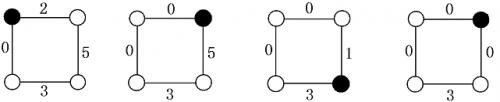
The results of each diagram are:
- $\text{A}$: It's Alice's turn;
- $\text{B}$: It's Bob's turn;
- $\text{C}$: It's Alice's turn;
- $\text{D}$: It's Bob's turn.
In $\text{D}$, when it's Bob's turn, both edges adjacent to the coin are $0$, so Alice wins.
Your task is to determine, based on the given ring, the values on the edges, and the starting position of the coin, whether the first player has a winning strategy.
Input Format
The first line contains an integer $N$ $(N \leq 20)$, representing the number of nodes on the ring.
The second line contains $N$ numbers, each no more than $30$, representing the values on the $N$ edges in order. The starting position of the coin is between the first and last edges.
Output Format
Output a single line. If there is a winning strategy, output YES; otherwise, output NO.
Sample Input and Output
Sample Input #1
4
2 5 3 0
Sample Output #1
YES
Sample Input #2
3
0 0 0
Sample Output #2
NO
输入格式
见题面 Input 部分
输出格式
见题面 Output 部分