题目描述
Problem Description
Given $n$ matchsticks, how many equations of the form $A+B=C$ can you form? The numbers $A$, $B$, and $C$ in the equation are integers formed using matchsticks (the highest digit cannot be zero unless the number is zero). The way to form the digits $0$ through $9$ with matchsticks is shown in the figure below:
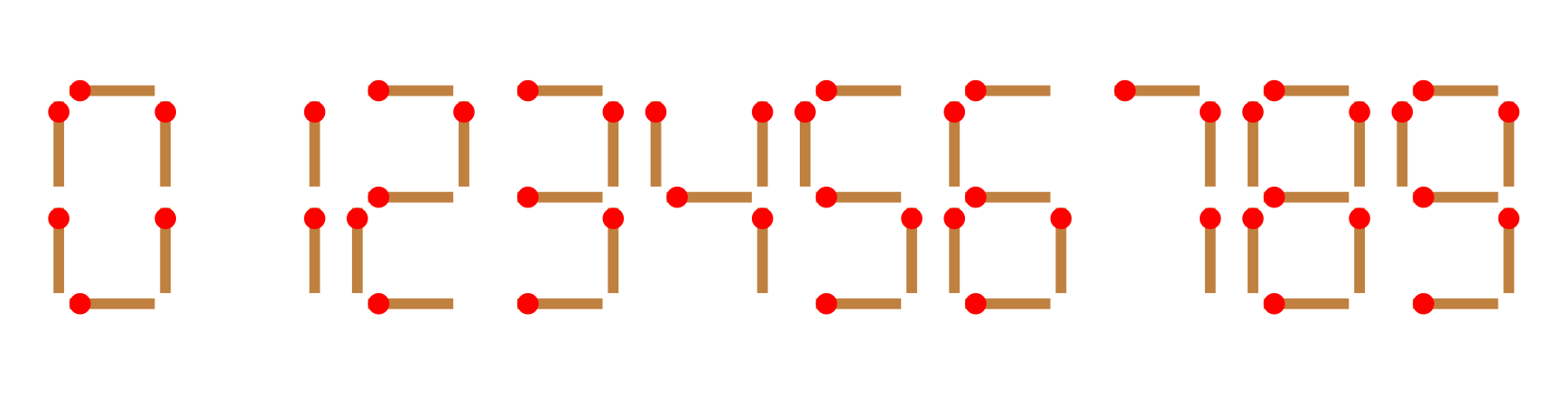
Notes:
- The plus sign and the equals sign each require two matchsticks.
- If $A \neq B$, then $A+B=C$ and $B+A=C$ are considered different equations ($A, B, C \geq 0$).
- All $n$ matchsticks must be used.
Input Format
A single integer $n$ ($1 \leq n \leq 24$).
Output Format
A single integer, the number of different equations that can be formed.
Sample Input and Output
Sample Input #1
14
Sample Output #1
2
Sample Input #2
18
Sample Output #2
9
Notes
Sample 1 Explanation:
The two equations are $0+1=1$ and $1+0=1$.
Sample 2 Explanation:
The nine equations are:
$0+4=4$, $0+11=11$, $1+10=11$, $2+2=4$, $2+7=9$, $4+0=4$, $7+2=9$, $10+1=11$, $11+0=11$.
This is the second question from the NOIP2008 Senior Group.
输入格式
见题面 Input 部分
输出格式
见题面 Output 部分
样例输入
14
样例输出
2