题目描述
Problem Background
Translated from ROIR 2023 D1T4.
There are $n$ points on a plane, denoted as $P_1, P_2, P_3, \dots, P_n$. The coordinates of the $i$-th point are $(x_i, y_i)$.
Select two points $P_i$ and $P_j$ ($i \ne j$). Let $P_i$ be the starting point and $P_j$ be the ending point. Centered at the ending point $P_j$, sort the points (excluding $P_j$) in a counterclockwise order starting from the direction of the vector $\overrightarrow{P_iP_j}$ (if angles are the same, sort by ascending distance to point $P_j$). Suppose the $t$-th point in the sorted order is $P_k$, then repeat the operation with $P_j$ as the starting point and $P_k$ as the new ending point, sorting and calculating the new ending point's index in the same manner. This process continues in a loop.
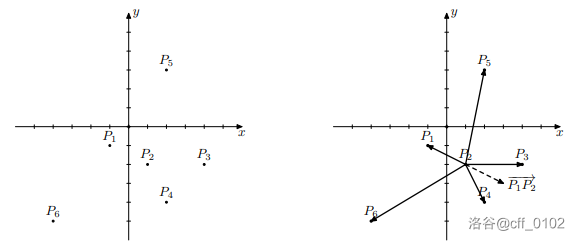
In the figure below, initially $n=6, t=4, i=1, j=2$. Sorting the points except $P_2$ in order gives $P_3, P_5, P_1, P_6, P_4$, so the next ending point should be $P_6$, with $P_2$ as the starting point.
Now $n=6, t=4, i=2, j=6$. Continuing the sorting as per the rules, as shown in the left diagram below, the result is $P_4, P_3, P_2, P_1, P_5$. Thus, the next ending point is $P_1$, with $P_6$ as the starting point.
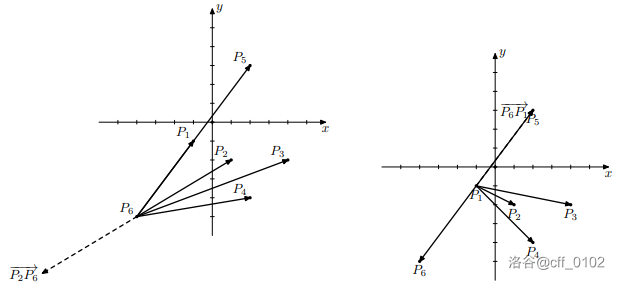
Now $n=6, t=4, i=6, j=1$. Continuing the sorting as per the rules, as shown in the right diagram above, the result is $P_5, P_6, P_4, P_2, P_3$. Thus, the next ending point is $P_2$, with $P_1$ as the starting point. At this point, we return to the initial situation, entering a loop.
Problem Description
We will color each of the $n$ points with one of three colors. The color of the $i$-th point is determined as follows:
- If there exists a point $j$ such that choosing point $i$ as the starting point and point $j$ as the ending point, point $i$ will become the starting point infinitely many times in the process described above, then color point $i$ green.
- If point $i$ is not colored green and there exists a point $j$ such that choosing point $i$ as the starting point and point $j$ as the ending point, point $i$ will become the starting point at least once more in the process, then color point $i$ blue.
- If point $i$ is neither green nor blue, then color point $i$ red.
Determine the color each point should be painted.
Input Format
The first line contains two integers $n$ and $t$.
The next $n$ lines each contain two integers $x_i$ and $y_i$. It is guaranteed that no two points coincide.
Output Format
Output a single line containing $n$ characters, where the $i$-th character represents the color of the $i$-th point.
Green points are represented by the letter G, blue points by the letter B, and red points by the letter R.
Sample Input and Output
Sample Input #1
6 4
-1 -1
1 -2
4 -2
2 -4
2 3
-4 -5
Sample Output #1
GGBBRG
Sample Input #2
2 1
1 1
2 2
Sample Output #2
GG
Notes
Sample $1$ Explanation:
From the example given earlier, it is known that $P_1, P_2, P_6$ form a loop and will be visited infinitely many times, so these points should be colored green.
When the starting point is $P_3$, choosing $P_1$ as the ending point, after sorting, $P_3$ is exactly the fourth point, thus bringing $P_3$ back to the starting point, as shown in the figure below. Therefore, it should be colored blue.

When the starting point is $P_4$, choosing $P_5$ as the ending point, after sorting, $P_4$ is exactly the fourth point. Therefore, $P_4$ can be colored blue. When $P_5$ is the starting point, it is easy to see that it cannot be colored green or blue, so it should be colored red.
This problem uses bundled test cases.
| Subtask | Points | Special Conditions |
|---|---|---|
| 1 | 10 | $n \le 10$, all points collinear |
| 2 | 15 | All points collinear |
| 3 | 10 | $n \le 10$, no blue points |
| 4 | 10 | $n \le 10$ |
| 5 | 15 | $n \le 100$, no blue points |
| 6 | 15 | $n \le 100$ |
| 7 | 5 | $n \ge 3$, all points form a strictly convex $n$-gon, input in counterclockwise order |
| 8 | 20 | None |
For all data, $2 \le n \le 1000, 1 \le t \le n-1, -10^9 \le x_i, y_i \le 10^9$.
输入格式
见题面 Input 部分
输出格式
见题面 Output 部分