题目描述
Problem Description
Given a decimal number $x$, convert it to a binary string and pad with leading zeros to make it 16 bits long. This results in a 16-bit binary string, which we use to represent a $4 \times 4$ chessboard, filling it from left to right and top to bottom with $0$ (white pieces) and $1$ (black pieces).
For example, $(447)_{10} = (0000 0001 1011 1111)_2$, filling the board in order (with $0$ as white pieces and $1$ as black pieces), results in the following chessboard (left board):
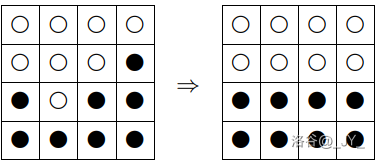
We can swap adjacent black and white pieces on the chessboard (two squares are adjacent if they share an edge, thus a square can have up to 4 adjacent squares). Transforming the left board to a board where all white pieces are on top and all black pieces are on the bottom (as shown on the right board) requires at least 3 steps.
For a given chessboard (guaranteed to have exactly 8 white pieces and 8 black pieces), find the minimum number of swaps needed to arrange the board with all white pieces on top and all black pieces on the bottom.
Input Format
Input consists of a single line containing an integer $x$, representing the chessboard in decimal form.
Output Format
Output a single line containing an integer, the minimum number of swaps required.
Sample Input and Output
Sample Input #1
447
Sample Output #1
3
Sample Input #2
42405
Sample Output #2
8
Notes
Sample Explanation
Sample 1
Refer to the diagram above, moving the black piece at $(2, 4)$ to $(3, 2)$ requires 3 steps.
Sample 2
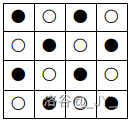
As shown in the diagram below, $(42405)_{10} = (1010 0101 1010 0101)_2$.
Data Size
50% of the test cases guarantee that the board can be arranged with white pieces on top and black pieces on the bottom within 6 swaps.
All data guarantees $0 \leq x < 2^{16}$, and when $x$ is converted to binary, it contains exactly 8 ones.
This problem originally had a full score of $20\text{pts}$.
输入格式
见题面 Input 部分
输出格式
见题面 Output 部分