题目描述
Problem Description
Let $e = 2.718\cdots$ be the base of the natural logarithm, and $\pi = 3.141\cdots$ be the ratio of the circumference of a circle to its diameter.
For a positive integer $ n $, define the real number $ f(n) $ as follows. Consider a circle $ C $ with center $ (0, 0) $ and radius $ 1 $ on the coordinate plane. Define points $P_0, P_1, \ldots, P_{n-1}$ on $ C $ such that the coordinates of $ P_j $ are $(\cos(2 \pi e j), \sin(2 \pi e j))$ for $j = 0, 1, \ldots, n - 1$. It can be proven that $P_0, P_1, \ldots, P_{n-1}$ are distinct, so $ C $ is divided into $ n $ arcs by these points. Let $ f(n) $ be the maximum length of these arcs.
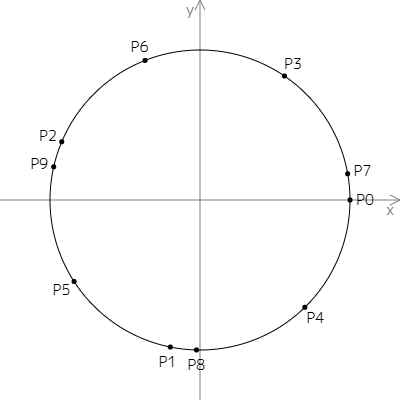 Illustration for $ n = 10 $
It can be proven that there are infinitely many positive integers $ n $ such that $ f(n) > f(n + 1) $. Let these integers be $n_1, n_2, \ldots$ in ascending order.
Given a positive integer $ K $, it can be proven that there uniquely exist integers $ a, b $ such that $f(n_K) = 2 \pi (a + e b)$. Find the remainders of $ n_K, a, b $ when divided by $ 998244353 $ (each should be between $ 0 $ and $ 998244353 - 1 $).
Input Format
The input is given from the standard input in the following format:
$ K $
Output Format
Output the remainders of $ n_K, a, b $ when divided by $ 998244353 $ in order.
Sample Input and Output
Sample Input #1
1
Sample Output #1
1 1 0
Sample Input #2
2
Sample Output #2
2 998244351 1
Sample Input #3
5
Sample Output #3
10 998244345 3
Notes/Hints
Constraints
- $1 \le K \le 10^{11}$.
Sample Explanation 1
$ n_1 = 1 $, $f(1) = 2 \pi$.
Sample Explanation 2
$ n_2 = 2 $, $f(2) = 2 \pi (-2 + e)$.
Sample Explanation 3
$ n_5 = 10 $, $f(10) = 2 \pi (-8 + 3 e)$.
输入格式
见题面 Input 部分
输出格式
见题面 Output 部分