题目描述
Problem Description
There is a circle with a radius of $1$, and vertices $1$ to $N$ are arranged clockwise.
The vertices divide the circumference of the circle into $N$ equal parts.
square1001 is trying to create a triangle by selecting three vertices.
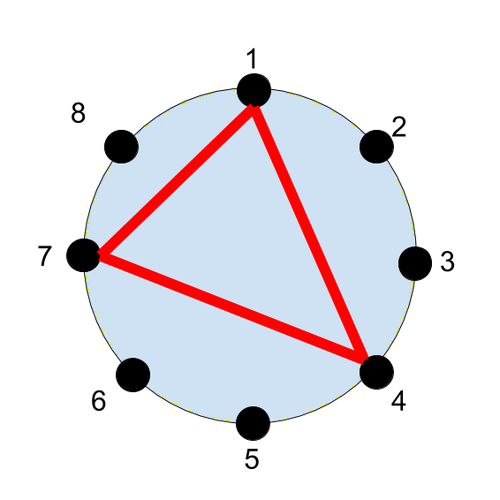
Among the $\frac{N(N-1)(N-2)}{6}$ possible ways to create a triangle, output the area of the triangle that is the $K$-th smallest in terms of area.
If there are triangles with the same area, it is sufficient to output the area, and the order does not matter.
For example, when $ N = 4, K = 3 $, it works as follows:
- When the vertex numbers are $ (1,2,3) $, the area $ = 1 $
- When the vertex numbers are $ (1,2,4) $, the area $ = 1 $
- When the vertex numbers are $ (1,3,4) $, the area $ = 1 $
- When the vertex numbers are $ (2,3,4) $, the area $ = 1 $
Therefore, the area of the 3rd triangle $ = 1.0 $.
Problem Author: E869120
Input Format
The input is given from the standard input in the following format:
$N\ K$
- The first line contains the number of points on the circumference $ N $ and the integer $ K $ representing the $K$-th triangle, separated by a space.
Output Format
- Output the area of the triangle that is the $K$-th smallest in terms of area.
- The answer will be considered correct if the absolute or relative error is at most $ 10^{-9} $.
Sample Input and Output
Sample Input #1
4 3
Sample Output #1
1.000000000000000000
Sample Input #2
6 9
Sample Output #2
0.86602540378
Sample Input #3
12 220
Sample Output #3
1.29903810568
Notes/Hints
Constraints
- $3 \le N \le 200,000$
- $1 \le K \le \frac{N(N - 1)(N - 2)}{6}$
Subtasks
Subtask 1 \[ $ 160 $ points \]
- $N \le 100$
Subtask 2 \[ $ 240 $ points \]
- $N \le 1000$
Subtask 3 \[ $ 450 $ points \]
- No additional constraints.
Sample Explanation 1
This input example is as explained in the problem statement.
Sample Explanation 2
When $ N = 6 $, there are 6 ways to choose vertices such that the area is $\frac{\sqrt{3}}{4}$, 12 ways to choose vertices such that the area is $\frac{\sqrt{3}}{2}$, and 2 ways to choose vertices such that the area is $\frac{3 \sqrt{3}}{4}$. Therefore, the area of the 9th triangle is $\frac{\sqrt{3}}{2}$.
Sample Explanation 3
When $ N = 12 $, there are $\frac{12 \times 11 \times 10}{6} = 220$ ways to create a triangle. The largest area is when the triangle is equilateral, so the area of the 220th triangle is $\frac{3 \sqrt{3}}{4}$.
输入格式
见题面 Input 部分
输出格式
见题面 Output 部分