题目描述
Problem Description
In the AtCoder Kingdom, the tallest tower, "AtCoder Tower," has $ N $ ornaments arranged in a straight line for Christmas.
There are $ N $ types of colors for the ornaments, numbered as color $ 1 $, color $ 2 $, color $ 3 $, ..., color $ N $. Initially, the $ i $-th ornament from the left in "AtCoder Tower" is color $ A_i $.
Now, Takahashi, the king, wants to make the decoration look "good" by removing some of the ornaments. A "good" state is defined as meeting all the following conditions:
- The number of remaining ornament colors is at most $ 2 $.
- No two adjacent ornaments have the same color.
For example, if you remove ornaments like \[A\] \[B\], it results in a "good" state.
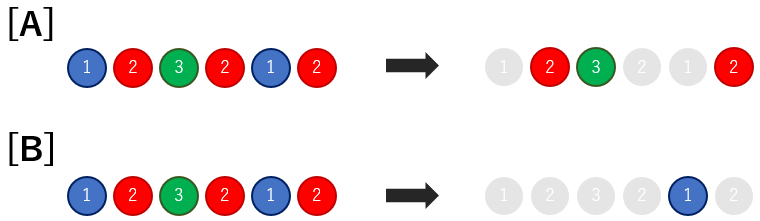
On the other hand, if you remove ornaments like \[C\] \[D\], it does not result in a "good" state.
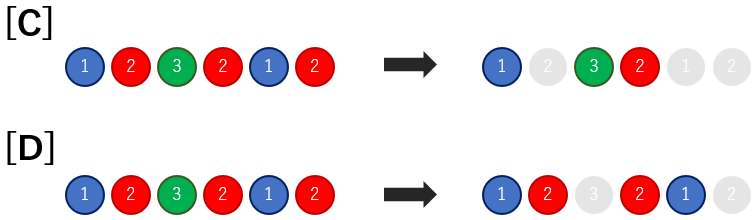
In "AtCoder Tower," the Christmas decoration is done over $ Q+1 $ days. On the night of the $ i $-th day, the color of the $ X_i $-th ornament from the left is changed to color $ Y_i $.
For each $ i = 1, 2, ..., Q+1 $, determine the following:
- If Takahashi wants to make the decoration look "good" at the beginning of the $ i $-th day, what is the minimum number of ornaments that need to be removed?
Input Format
The input is given from the standard input in the following format:
$ N $ $ A_1 $ $ A_2 $ $ A_3 $ ... $ A_N $ $ Q $ $ X_1 $ $ Y_1 $ $ X_2 $ $ Y_2 $ $ X_3 $ $ Y_3 $ : $ X_Q $ $ Y_Q $
Output Format
Output $ Q+1 $ lines. The $ i $-th line should contain the minimum number of ornaments that need to be removed to make the decoration look "good" at the beginning of the $ i $-th day.
Sample Input and Output
Sample Input #1
1
1
0
Sample Output #1
0
Sample Input #2
10
1 3 4 2 3 1 4 2 1 4
0
Sample Output #2
4
Sample Input #3
12
8 9 9 4 4 11 11 8 4 9 9 4
10
3 9
1 4
2 9
10 11
7 4
1 8
3 8
6 9
6 8
2 9
Sample Output #3
8
8
7
7
7
7
7
7
6
6
6
Notes/Hints
Constraints
- $1 \leq N \leq 3,000$
- $0 \leq Q \leq 7,000$
- $1 \leq X_i \leq N$
- $1 \leq Y_i \leq N$
- $1 \leq A_i \leq N$
- All inputs are integers.
Partial Points
This problem is divided into several sub-tasks. Your score is the sum of the points for the sub-tasks you solve correctly.
- (2 points) $ N = 1 $, $ Q = 0 $.
- (11 points) $N \leq 15$, $ Q = 0 $.
- (12 points) $A_i \leq 2$, $Y_i \leq 2$.
- (13 points) $N \leq 250$, $ Q = 0 $.
- (18 points) $ Q = 0 $.
- (44 points) No additional constraints.
For sub-task 6, scoring is as follows:
- Correct on all test cases where $Q \leq 600$ to get 24 points.
- Correct on all test cases where $Q \leq 1,500$ to get an additional 5 points.
- Correct on all test cases where $Q \leq 2,500$ to get an additional 5 points.
- Correct on all test cases where $Q \leq 4,500$ to get an additional 5 points.
- Correct on all test cases to get an additional 5 points.
Hint for Sub-task 3
In this sub-task, the color of the ornaments is either color $ 1 $ or color $ 2 $ for any day. This means that the "good" state can only be achieved by alternating colors $ 1, 2, 1, ... $ or $ 2, 1, 2, ... $ from left to right. Consider this hint when tackling sub-task 3.
Sample Explanation 1
In this input example, the decoration is already in a "good" state without removing any ornaments. Therefore, the correct output is $ 0 $.
Sample Explanation 2
As shown in the figure below, removing 4 ornaments results in a "good" state.

This input example satisfies the constraints of sub-task 2.
Sample Explanation 3
Since $ Q = 10 $, you need to output 11 lines.
输入格式
见题面 Input 部分
输出格式
见题面 Output 部分