题目描述
Problem Description
In Daiku Cho's town, road construction is underway. The town has $ N $ intersections and $ M $ roads, with each road connecting two different intersections bidirectionally. Unfortunately, it is not guaranteed that one can travel from any intersection to any other using the existing roads.
Daiku Cho's construction company wants to build some roads connecting different intersections so that one can travel from any intersection to any other using the roads.
Determine the minimum number of roads needed to ensure that one can travel from any intersection to any other using the roads. If it is already possible to travel from any intersection to any other using the existing roads, output $ 0 $.
Input Format
The input is given from the standard input in the following format:
$ N $ $ M $ $ a_1 $ $ b_1 $ $ a_2 $ $ b_2 $ : $ a_M $ $ b_M $
- The first line contains two integers $N\ (1\ ≦\ N\ ≦\ 100,000)$ and $M\ (0\ ≦\ M\ ≦\ 100,000)$, representing the number of intersections and the number of existing roads, respectively, separated by spaces.
- The next $ M $ lines contain information about the existing roads. The $ i $-th line contains two integers $a_i,\ b_i\ (1\ ≦\ a_i\ ≦\ N,\ 1\ ≦\ b_i\ ≦\ N)$, representing the two intersections connected by the $ i $-th road, separated by spaces.
- No road connects the same intersection. That is, for $i,j\ (1≦i,j≦M)$, if $ i≠j $, then $ a_i≠a_j $ or $ b_i≠b_j $.
Output Format
Output the minimum number of roads that need to be constructed in the first line.
Do not forget the newline at the end.
Sample Input and Output
Sample Input #1
4 2
1 2
1 3
Sample Output #1
1
Sample Input #2
6 4
1 2
2 3
1 3
5 6
Sample Output #2
2
Notes/Hints
Sample Explanation 1
Intersections $ 1 $, $ 2 $, and $ 3 $ are connected by roads, but intersection $ 4 $ is not connected. For example, building a road connecting intersections $ 1 $ and $ 4 $ would be sufficient. 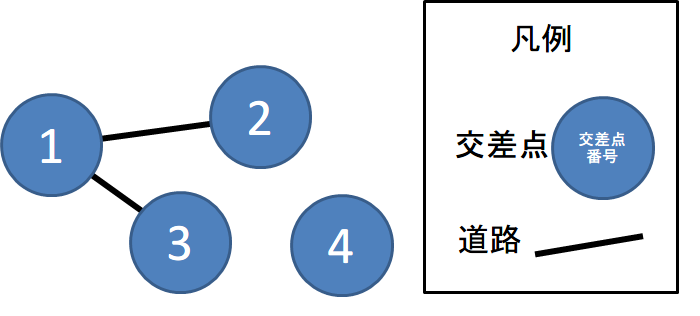

输入格式
见题面 Input 部分
输出格式
见题面 Output 部分